

Day 1: Lima, Peru.
Our adventure begins in Lima, the cosmopolitan capital of Peru, where we will welcome you upon arrival at the airport and transfer you to our hotel. Enjoy dinner on your own this evening.
Day 2: Cusco / Sacred Valley — Hacienda Sarapampa / Urco / Huyallabamba
This morning, we will fly to Cusco, heart of the once-grand Inca Empire. Cusco, whose name comes from the Quechua word qosq’o, means “navel of the earth.” Located in an Andean valley, Cusco was founded in the 12th century and prospered until the Spanish conquistadors destroyed the Inca civilization during their colonial expansion in the 16th century.
We will learn more about this legendary city as we explore the main square before departing for the Sacred Valley. We will stop for a special lunch at Hacienda Sarapampa, a family-run farm surrounded by towering Andean peaks, where we will enjoy a farm-to-table feast with local ingredients such as quinoa, choclo (giant corn), fresh cheese, and more. We will learn about traditional agricultural techniques that have been sustainably maintained for three generations while sampling a selection of authentic Peruvian dishes.
In the afternoon, we will explore the little-visited archaeological site of Urco. Once a ceremonial place dedicated to water rituals and sacred cosmology, this peaceful location invites reflection on the profound spiritual bond between ancient pre-Columbian civilizations and the natural world. As we walk among terraces, canals, carved stones, and Inca caves, we will listen to the stories that continue to flow through the stone and stream. Finally, we will arrive at our luxurious hacienda-style hotel, perched on a hillside with imposing, lush green peaks as its backdrop.
Day 3: Exploring the Sacred Valley of the Incas
Today, as we follow the Urubamba River, we discover more treasures of the Sacred Valley, flanked by golden hills dotted with traditional villages, small farms, and Inca architectural ruins. The vast original Inca Empire was connected by a network of 16,000 kilometers of stone roads that wound through the formidable Andean terrain—no easy task considering the steep slopes and high altitude. Suspension bridges crossed rivers, and aqueducts carried water from mountain streams to irrigate terraced agricultural fields, remnants of which we will see today against a dramatic mountain backdrop.
During a visit to Maras, you will admire the pre-Inca salt mines where salt has been harvested for more than a thousand years. The intricate network of shallow pools carved into the hillside gleams as mineral-rich water from underground streams fills the pans and evaporates, leaving behind layers of fine salt. We then head to the Ensifera Hummingbird Garden, where a picnic lunch awaits, along with a lecture on hummingbirds by a local expert. Depending on available time, we may also visit the agricultural terraces of Yucay or have the opportunity to meet a local shepherd. In the afternoon, you will have time to relax at the hotel before dinner, enjoying views of the valley and towering green mountains.
Day 4: Ollantaytambo / Vistadome Train to Aguas Calientes / Machu Picchu
We continue to Ollantaytambo, where we stop to explore its remarkable ruins before boarding our train. This small town sits atop traditional Inca foundations and is one of the best preserved examples of Inca urban planning. The spectacular hilltop Inca fortress stands as an exceptional site where Spanish conquistadors were once defeated.
We then board our Vistadome railcar for a 90-minute journey along the Urubamba River, which narrows and becomes turbulent as we enter the mountains. The views of the steep Andean slopes become more dramatic at every turn. In the town of Aguas Calientes, we disembark and board a bus for the final short ride to Machu Picchu, the ancient “Lost City of the Incas.”
The legendary ruins soon come into view, rising atop a mountain carpeted by dense jungle like a vision in the clouds. Although Machu Picchu is undoubtedly the most famous archaeological site on the continent, it still retains an aura of mystery. Our guide will help interpret everything we see as we explore the maze of granite houses, temples, cisterns, intricate passageways, and steep staircases. Llamas wander among the stepped terraces where corn and potatoes were once grown for the roughly 1,200 inhabitants who lived here in the 15th century. Archaeologists believe Machu Picchu may have been both a royal estate and a sacred retreat based on its geography and astronomical alignment. Important ceremonies were held here, including a winter solstice ritual in which a priest symbolically tied the sun to a stone to prevent it from disappearing.
Tonight, we stay at the Inkaterra Machu Picchu Pueblo Hotel, located on a forested hillside near Aguas Calientes. Our private casitas are surrounded by the lush vegetation of the cloud forest, where more than 300 varieties of orchids flourish in the gardens of this luxurious, secluded riverside retreat.
Day 5: Machu Picchu / Wayna Picchu / Cusco
This morning, we return to Machu Picchu to continue exploring, with free time for personal discovery. Among the ruins, take the opportunity to reflect, in the words of Hiram Bingham, on the “bewildering romance” of a place that “seems to have been expressly designed by nature as a sanctuary for the oppressed.”
Or, for those with energy and interest, climb to the summit of Huayna Picchu, the towering mountain famously seen behind the ruins in classic photographs. The Incas built the original trail to the top, where they constructed temples and terraces. According to local legend, the summit of Huayna Picchu was the residence of the high priest of the ancient city. This challenging hike takes 2–3 hours and ascends about 365 meters from the base of Machu Picchu, climbing steep slopes aided by stairs and cables. The hike is not recommended for those with physical limitations or fear of heights; those who choose not to participate may explore other areas with a local guide. If Wayna Picchu tickets are sold out, an equally demanding hike to the summit of Machu Picchu Mountain may be available. This afternoon, we take the train back to Ollantaytambo and then drive to Cusco.
Day 6: Cusco — City Tour / Sacsayhuamán
Nestled in an Andean valley, Cusco was the capital of the Inca Empire until the Spanish conquistadors destroyed the civilization during their colonial expansion in the 16th century. Today, we take a guided tour through the rich history of Cusco as we stroll its narrow cobblestone streets, pausing to admire remnants of the Inca Wall, the Plaza de Armas, and colonial churches richly adorned with gold.
Continuing to Sacsayhuamán on the outskirts of the city, we observe the imposing granite structure that represents the finest example of Inca stonework in the Cusco region. We walk among the centuries-old ruins and marvel at the enormous granite blocks, fitted so precisely that not even a razor blade can slip between them. Thanks to the Incas’ exceptionally advanced construction techniques, the walls have survived the earthquakes that devastated the city below.
Day 7: Cusco / Lima / Iquitos / Nauta — Embarkation
Fly to Lima this morning and then continue to Iquitos. Crossing the Andes, we arrive in this remote urban enclave that was once a thriving rubber-boom center. Today, Iquitos stands isolated in a vast expanse of rainforest and is accessible only by air or water. We continue to Nauta, about 96 kilometers away, in a comfortable private vehicle on paved roads.
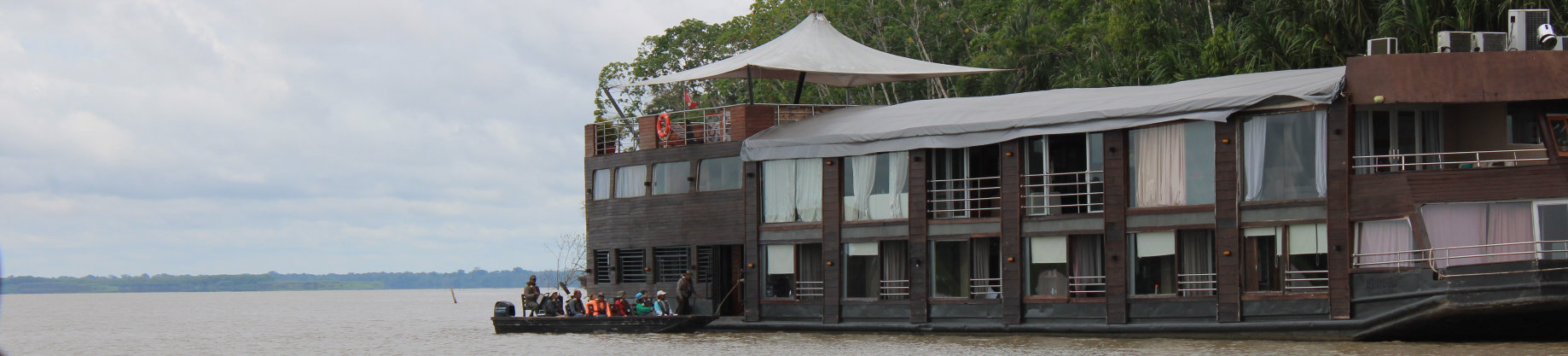
Observing scenes of everyday life in the rainforest, we reach this small riverside town on the banks of the Marañón River—the literal “end of the road” and our embarkation point for the Delfín II. The vessel soon glides across the vast river, one of the two largest tributaries of the Amazon, muddy from its milk-chocolate-colored silt. On the observation deck, our guides provide an introduction to the journey, covering the places we will visit, the wildlife we expect to see, and a brief historical and geographical overview of the Amazon Basin. At sunset, enjoy a gourmet dinner with panoramic river views. The chef specializes in creative preparations of Peruvian cuisine with an international flair, making each meal a memorable discovery.
Day 8: Birthplace of the Amazon — Pacaya Samiria National Reserve
This morning, we travel by skiff to one of the most protected areas of the Pacaya Samiria National Reserve. Established in 1982 to preserve the exceptional biodiversity of northern Amazonia, this 2-million-hectare reserve—spanning the headwaters of the Amazon—is the largest protected area in Peru.
In this region, where the Yanayacu and Pucate rivers meet, we will search for pink river dolphins. We also participate in a special conservation activity to help protect taricaya turtles (yellow-spotted river turtles). Due to poaching of their eggs, these small turtles have become an endangered species. During this hands-on project, we may help prepare nesting areas for the turtles to lay their eggs or release hatchlings into the river. The eggs are incubated on semi-natural beaches and monitored by park rangers until they hatch. Their nests face threats from ants, hawks, hens, iguanas, and other animals, making the constant vigilance of dedicated caretakers crucial for their survival.
We also take part in a tree-planting ceremony, part of an extensive reforestation initiative. Later, we have the opportunity to go kayaking and visit the community of San Regis, where we learn about local ways of life, including ancestral traditions passed down by the village shaman. Our visit includes a market where women from the community sell their handicrafts.
Day 9: Confluence of the Ucayali and Marañón / Yarapa River / Village Visit
Wake up at the confluence of the Ucayali and Marañón rivers, where they join to form the main channel of the mighty Amazon River. Sailing along the Ucayali, we reach the mouth of a remote tributary of the Upper Amazon—the Yarapa River—where we board skiffs to observe colorful birds such as the purple-throated cotinga and search for pink and gray river dolphins that sometimes glide gracefully through the dark waters beside us. These freshwater dolphins are highly sociable, friendly, and intelligent. According to local lore, the dolphins transform into humans during festivals to steal handsome men or beautiful women from their villages.
As we explore the most secluded corners of the Yarapa, look up for troops of curious squirrel monkeys. At every turn, our guides reveal the secrets and surprises of the rainforest.
We will also travel by skiff to a riverside village where we meet indigenous residents whose culture has endured for centuries. In the handicraft market, we can purchase items that support the community and empower women artisans. Sales indirectly contribute to wildlife conservation since the income reduces the appeal of poaching.
Passengers aboard the M/V Agua Marina will have the opportunity to meet the region’s renowned local shaman, known throughout the area as a healer and spiritual guide for people living in the most remote zones. You will learn about the uses of various medicinal plants from the world’s largest pharmacy: the Amazon rainforest.
Day 10: Nauta — Disembarkation / Iquitos / Lima / Departure
Disembark in Nauta this morning, and on the way to Iquitos, stop to visit the Amazon Aquarium, a research center that contributes to the preservation of Amazonian biodiversity through the study and conservation of more than 300 species of ornamental fish. Ideally located in an area with natural springs flowing year-round, the center works to create a long-term balanced ecosystem that enhances the environment and benefits the local economy. Through ongoing education and practical training, local fishermen learn to establish and maintain sustainable aquaculture of ornamental fish, while local residents learn key principles of conservation.
We then fly together to Lima. For your convenience, we have reserved rooms at a comfortable hotel near the airport. Relax in your private space until your evening flight home, or take the opportunity to spend the full night and depart the next morning.
Note: This itinerary is a guideline and may be modified due to weather conditions, domestic flight schedules, and river water levels. At times, these conditions may require us to deviate from our planned itinerary, in which case we will offer the best possible alternative—and turn it into a wonderful adventure!
Some departures, as indicated, will operate in reverse, visiting the Amazon first before traveling to Cusco, the Sacred Valley, and Machu Picchu. All itineraries begin and end in Lima, and all included services remain the same.